

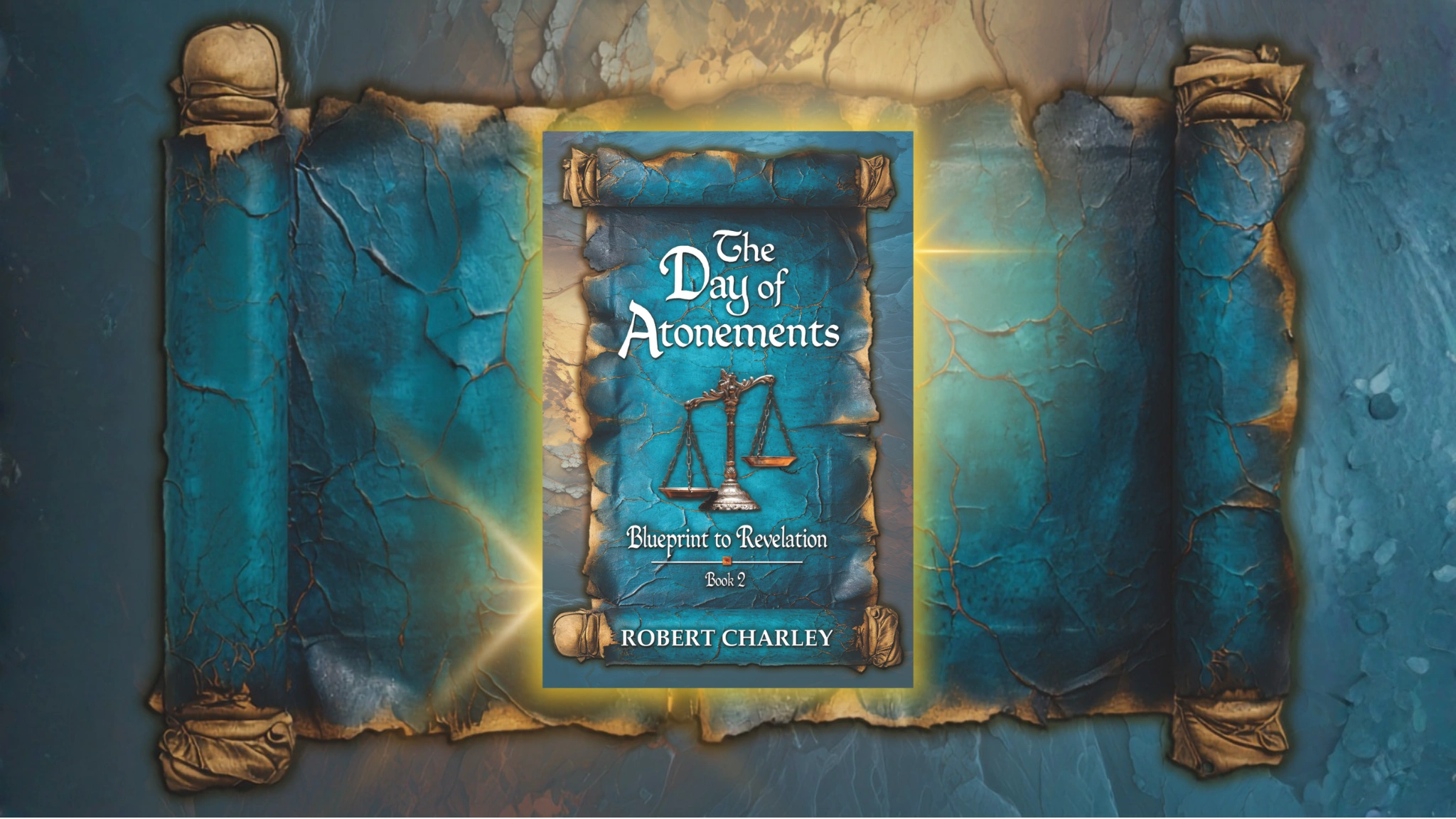
The Day of Atonements by Robert Charley
“Leads readers through some of Revelation’s harshest scenes and finds, beyond them, not an ending in ashes but the beginning of a restored world.”
For readers who followed Robert Charley through the seals and horsemen of The Feast of Trumpets: Blueprint to Revelation (our review here), the second book in his trilogy opens at a more ominous threshold. In The Day of Atonements: Blueprint to Revelation, judgment is no longer being weighed. The verdict has arrived.
Covering Revelation 8–16, Charley turns to the Day of Atonement as the next stage in his interpretive framework. The trumpets sound. The two witnesses take their stand. The Beast rises, and the bowls of wrath follow. Charley does not treat these events as spectacle for its own sake. He sees them as part of a process in which sin is confronted and creation is prepared for renewal.
The Ritual That Organizes the Chaos
Charley’s argument begins with the title. He uses the plural “Atonements” because the Hebrew Yom HaKippurim refers to more than one act of atonement. In Leviticus 16, atonement is made for the High Priest, his household, the people, the sanctuary and the altar. Charley builds the book around that sequence, arguing that Revelation concerns the cleansing of the earth as well as the judgment of humanity.
The two goats used in the ancient ceremony become central to his reading. One is offered to God. The other carries the people’s sins into the wilderness “for Azazel.” Charley sees in them a pattern of separation that runs through Revelation. Those who accept Christ’s sacrifice are covered by His blood. Those who give themselves to the Beast’s system remain answerable for their own sin.
This gives shape to a section of Revelation that can otherwise feel like one calamity after another. The fire cast from the heavenly altar, the trumpet judgments and the final bowls all belong to the same movement toward purification.
Charley is on especially firm ground when he traces Revelation back through earlier biblical events. The seven trumpets recall Jericho. The plagues echo Egypt. The two witnesses resemble Moses and Elijah. The 144,000 are compared with Israel’s army being counted before entering the Promised Land. In his reading, Revelation is not a strange prophesy detached from the rest of Scripture. It gathers up patterns that have been developing all along.
Scholarship With a Human Voice
As in the first volume, Charley writes less like a distant scholar than a guide thinking aloud beside the reader. He moves among Hebrew word studies, Jewish traditions, commentaries and several Bible translations. Although Charley is firm about his central framework, he often approaches individual symbols by posing several possible interpretations.
His personal stories help ground the theology. While discussing the locust-like creatures from the bottomless pit, Charley recalls being stung by a two-inch scorpion while watching a movie at home. He uses that memory to sharpen Revelation’s image of torment lasting for months. It is a brief, physical moment in a book crowded with angels, armies and global judgment, and it makes the passage easier to feel.
This volume also ventures further into contemporary speculation. Charley considers whether Wormwood might be an asteroid, whether the beings from the bottomless pit could be understood as supernatural entities or genetic hybrids, and whether artificial intelligence, implanted payment systems or transhumanism might figure in the Beast’s rule. He also discusses CERN and UFO disclosure.
These sections are intriguing, yet Charley’s strongest arguments are the ones built directly from Leviticus, Exodus, Joshua, Daniel and Revelation. The modern parallels are best read as possibilities rather than proof, and Charley often presents them that way.
Beneath the speculation, his pastoral concern remains steady. He keeps returning to the response he believes Revelation demands: repentance, faithfulness and the willingness to endure.
Judgment in Service of Renewal
The final chapters are the book’s strongest sustained stretch because Charley brings the plagues, the two goats and the Jubilee back into the same frame. The bowls of wrath are compared with Egypt’s judgments. The Beast and False Prophet become counterfeit rulers standing in Pharaoh’s place. The ritual of the goats explains the eventual removal of evil.
Then comes the Year of Jubilee, with its release of captives, restoration of land and resetting of time. That image changes the emotional direction of the book. Revelation does not end, in Charley’s interpretation, with ruins. Judgment clears the way for a different order under Christ.
The epilogue draws that vast prophetic vision back to the individual reader. Charley briefly reflects on his own spiritual path and ends with a direct appeal to choose life while the opportunity remains.
The Day of Atonements is an ambitious continuation of Charley’s project. It provides Revelation 8–16 a coherent structure and links its difficult imagery to older biblical patterns. Charley leads readers through some of Revelation’s harshest scenes and finds, beyond them, not an ending in ashes but the beginning of a restored world.

Genre: Religion
Author: Robert Charley