


For Interpol, some things are still best done at home. And for this journeyman post-punk band, home has always meant New York City, even as its members have scattered around the world.
Guitarist and co-founder Daniel Kessler splits his time between the city and Barcelona. Singer Paul Banks has settled in Berlin with his family, while keeping an apartment in Manhattan. It had been a decade since Interpol last recorded an album in New York, making This Mirror Weighs a Ton a consequential return to the nocturnal landscape that helped define them.
The new album’s title song emerges from a haze of atmosphere and gloom, built from layers of guitar, swirling effects, and a heartbreak beat, as Banks croons lyrics both hard-edged and impressionistic: “I fall in a hole (loser) / Fade in symphonic / Like the phone that’s dialing / Alone again / Unknown again.”
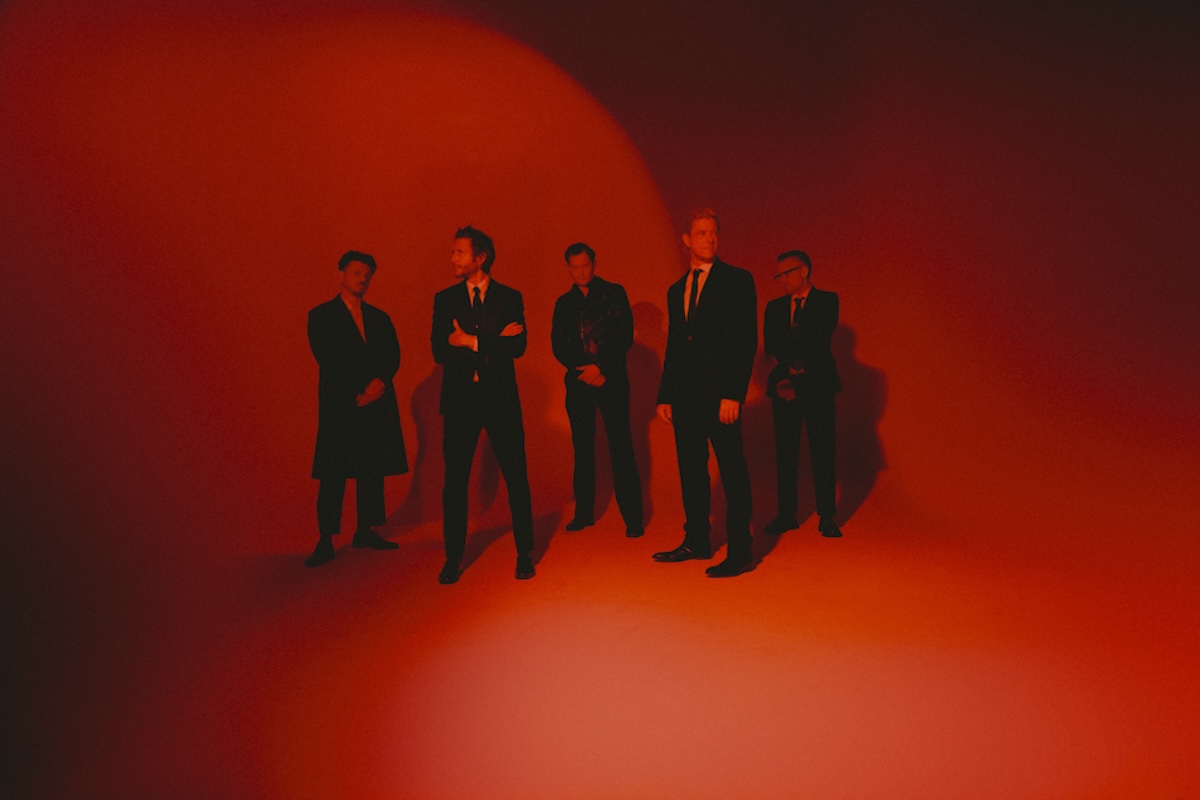
A quarter-century after their debut, Interpol remain energized by that initial burst of creativity and fame, rising from the same early-2000s rock scene in New York that birthed the Strokes, Yeah Yeah Yeahs, and LCD Soundsystem. Still dressed in black and performing beneath columns of mood lighting, the band is also exploring some new territory, with Kessler on “So Rides the Reindeer” playing acoustic guitar on an Interpol record for the first time. On “Wounded Soldier,” Banks draws inspiration from the grim drone imagery from the war in Ukraine.
Produced by their friend Andrew Wyatt (Charli xcx, Rosalía), the album was recorded several stories above the Lower East Side, in a studio with big windows overlooking the New York skyline. “It was really amazing to make this record and have these windows that looked out on Gotham,” Kessler tells SPIN.
The world outside sometimes played a part in the music being made. Kessler recalls the sound of flocks of birds that were often nearby picked up by the microphones. “The birds came out and made a singing sound at the top of the morning,” the guitarist says, “and then at the end of the night. It was a really sweet thing to catch.”

This is the first album Interpol has made in New York in 10 years, which is a little surprising. What brought you back?
I love making records here, and we’ve also made a number of records here. The last two just happened to be with people who, if you want to work with them, you have to go where they’re working. This time, it wasn’t so much a conscious decision as we wanted to work with our friend Andrew Wyatt, and he’s a New Yorker, born and bred.
He was just about to open a studio here in New York as well, and obviously, most of us have places in New York, so it just made sense. We’ve written pretty much all of our records here. COVID made it a little bit more challenging with the previous record, so we had to do it a little bit more remotely and so forth. But beyond that, we’ve always written in New York City.
How did This Mirror Weighs a Ton come to life?
The songs typically begin with me, working at home on a classical guitar, and then some of these songs I started with a piano. They become Interpol songs by us getting together in the room and building them out. This record we wrote with our longtime live touring bassist, Brad Truax, so that made a big difference. He never played on a record before with us.
Do you still come up with song ideas while you’re watching movies?
I do. That’s my ritual. I still really love it so much. It’s not something I can do on tour, but it’s something once I’m home, I will start every day with a movie and coffee in New York. I have the same classical guitar I got when I was 14 years old, and if something can pop out at me on that thing, it usually means there’s something to build on there. It’s very rare in life that things you love doing as a teenager you still love doing way beyond your teenage years. It’s a luxury that I get to start my day this way.
Do you choose your movies based on something you’re aiming for, or is it just random?
It’s pretty random. It has nothing to do with what I’m hoping to create or anything like that. I’m just trying to find something that’s going to resonate with me. I like the visual distraction, the visual stimulation. I don’t really like technology very much. I don’t really like getting better at technology. I lose patience when things don’t work out, so there’s something about trying to write in this format, distracting myself, taking off the pressure, sitting down and writing on a classical guitar. I like the tone and the warmth of it. There’s something about that I hold onto even more in this crazy technological age.
What do your movie tastes lean towards?
I don’t think I’m too much of a snob, but I do like some foreign films from back in the day and so forth. I’m certainly very much looking forward to seeing The Odyssey, for instance. And not thinking about the outside world for those two to three hours is ideal, right? That’s a real gift. The last film that I saw, at the Film Forum [in New York] was this Claude Lelouch film called A Man and a Woman [1966] that was really incredible.
I’m guessing that if you’re watching, say, Apocalypse Now versus a Will Ferrell movie, the song you’re writing is going to be affected by that.
Yeah. I don’t know if I would try to write in the morning to a Will Ferrell movie. I might try to watch that later in the evening, but Apocalypse Now for sure. What a film, you know? But the film doesn’t have to be abstract and leave you longing and searching for answers and so forth. It could be a classic piece of entertainment.
On the new album is “Enemy,” a piano-based song. Did it start out on your acoustic?
That was definitely piano. I live part-time in Barcelona, where I have a piano. I don’t live [in the same house] anymore, but it was a very old building from the 17th century. It had very high ceilings, and it almost had a very church-like vibe to it. And these really gigantic shutters cast these long shadows. I lived in a neighborhood that did not get a lot of sunlight except for certain hours of the morning, but certain mornings the light would hit it, and it would give these reflections. When I think of working on that song, the piano progression has a mantra meditation vibe to it. It’s repetitive and it’s insistent.
There’s also tracks like “Ever the Actor,” which really erupts with guitars mid-way, which must be a different experience when creating it.
I really feel the collaboration of the band on that one. My guitar feels a little bit—in my brain, at least—like an Americana kind of vibe to it. But then you get to these choruses that start becoming dark and ominous, both from Paul’s vocal delivery, and the guitar, but then meshed in with these hip-hop kind of beat moments. Then Andrew arranged these beautiful strings to go along with it, and these atmospherics and orchestrations.

When you hand over a song that you’ve started to Paul, and then he comes up with his parts, is it always a surprise to you, or do you sense how he’s going to react to certain things at this point?
When we’re in the room, and I’m just playing the song that I’ve written, everything is open. Paul’s an amazing artist and has an incredible ear. Usually there’s something that speaks to him right away, and he’s reactive to it. It’s not cerebral. He just starts doing something. As we’ve made more and more records, he’s been really good about jumping in right away from a vocal standpoint, whatever first comes to him.
Interpol has had a consistent visual aesthetic over time. Where does that come from?
Truthfully, it’s not like a band decision, and it never has been. For me, I wear a suit every day. It’s my comfort. I think as soon as I decided to start wearing suits, I was like, oh, this is simpler, and it feels more like me. Something about that aesthetic always appealed to me. I remember being a really young kid in London seeing the Specials. Even then as a 5-year-old, I thought these are the coolest people out there.
When you see the early ’60s or ’50s French cinema or Italian cinema, they’re always in these styles, and the aesthetics always appealed to me—the tight-fitting trousers. It wasn’t something very common you’d see, like, on the streets of New York in the late ’90s and so forth. Certainly between Carlos [Dengler, former bassist and co-founder] and myself, that was something we had in common. I’m very consistent. I wear the exact same outfit. The suit that just feels right to me. But Paul, he’ll mix it up a lot more than I will.
With the other projects you guys do outside of Interpol, what do you think having those experiences brings back to the band?
I think it’s a healthy thing to do something completely different in life and go in a different direction. And then you come back with different experiences that you can take back into the band and go from there. For me, my side project with Big Noble, it’s more like music for film. I work with a friend of mine [Joseph Fraioli] who’s a sound designer for film, and he comes from the electronic music world as well. It’s a healthy thing to keep things growing and expansive and satisfying.